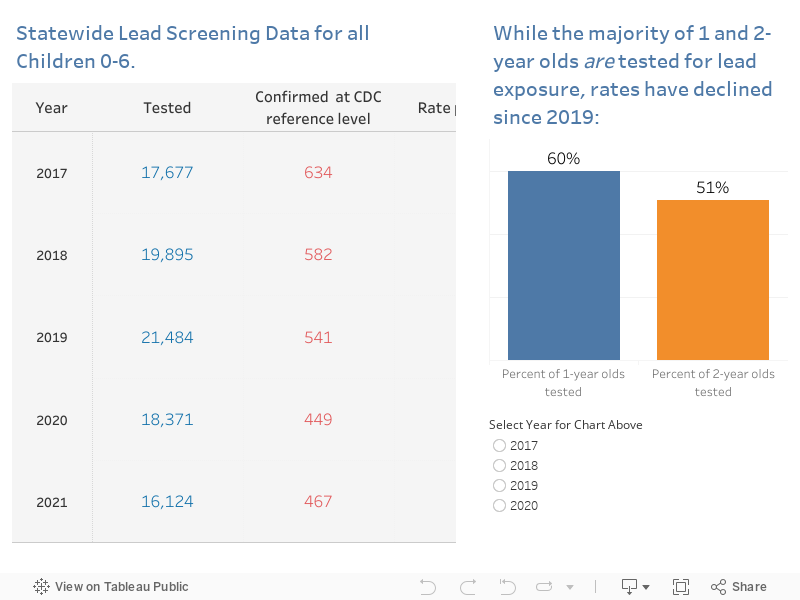
In states like New Hampshire, with the majority of homes built before the 1978 ban on lead-paint, it is too common that children are exposed to lead. Because even low levels of lead in blood have been shown to affect IQ, ability to pay attention, and academic achievement, preventing and addressing exposure is critical to children’s long term health.
Data by direct request to New Hampshire Department of Health and Human Services, Division of Public Health Services, Bureau of Community Health Services, Healthy Homes and Lead Poisoning Prevention. The program releases data on the NH DHHS Data Portal
Note that the CDC decreased the reference level from 5 micrograms per deciliter (ug/dL) to 3.5 in October of 2021. Data from 2022 and beyond reflect that. The 2021 figure of 467 includes 430 children (72 months or younger) who tested at or above the 5 ug/dL before October, 2021, and the 37 children who tested at or above the 3.5 ug/dL after October 2021.
with support from